
- 17 Mart 2026
- 2960 defa okundu.
Street and Field: Hygiene, Disease, and Death Across Spaces and Ages International Symposium
Kadir Has Üniversitesi, Sanat ve Tasarım Fakültesi tarafından düzenlenen "Street and Field: Hygiene, Disease, and Death Across Spaces and Ages" başlıklı uluslararası sempozyum için 12 Nisan 2026 tarihine kadar özet gönderimi yapılabiliyor.
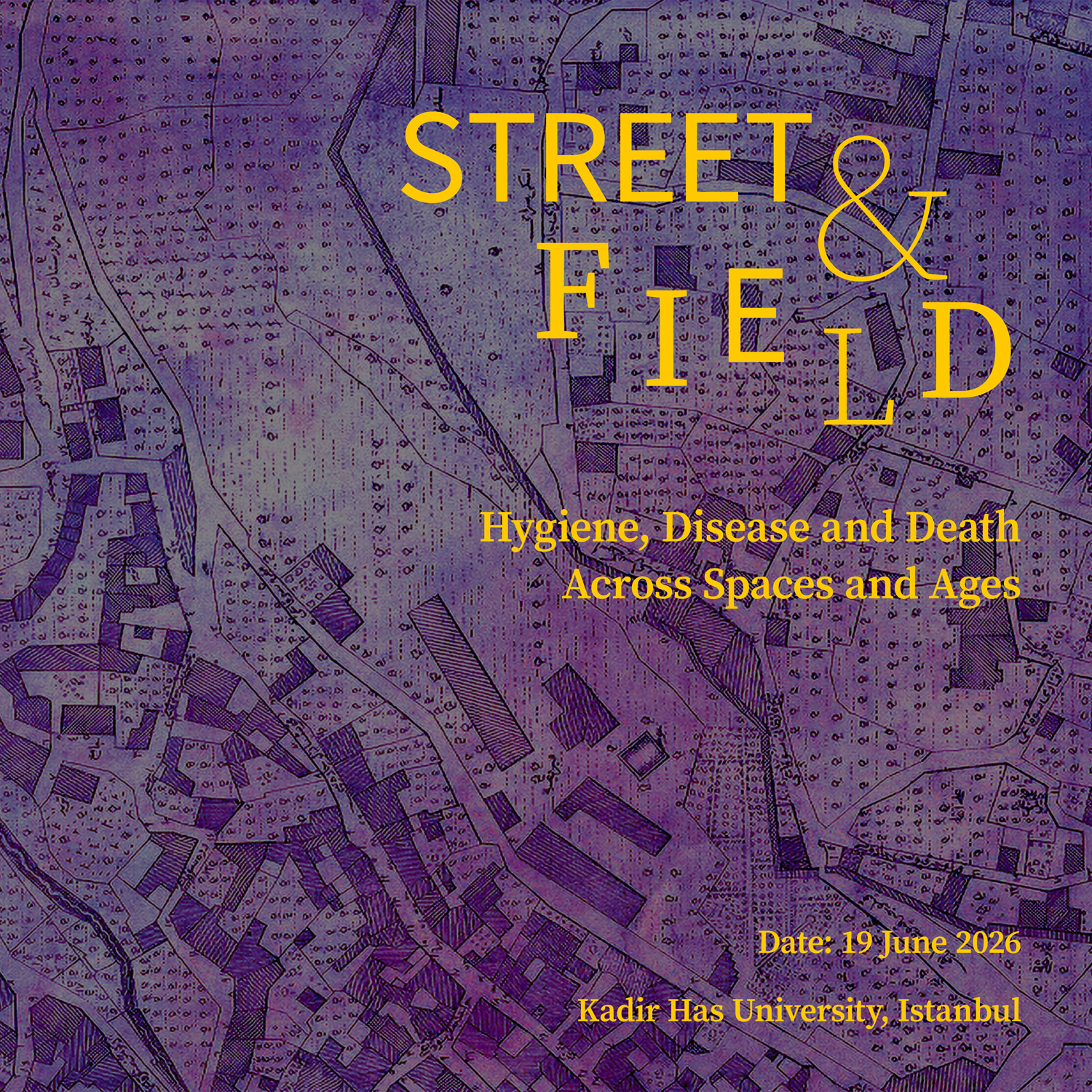
Kadir Has Üniversitesi, Sanat ve Tasarım Fakültesi “Street and Field: Hygiene, Disease, and Death Across Spaces and Ages” başlıklı uluslararası bir sempozyuma ev sahipliği yapmaya hazırlanıyor. Sağlık, hastalık ve ölümün mekânsal boyutlarını odağına alan etkinlik, sokak ve tarla kavramlarını hem fiziksel hem de kavramsal düzlemde ele alarak kent ve kırsal ayrımın ötesine geçen tartışmalar açmayı hedefliyor. Farklı disiplinlerden araştırmacıları bir araya getirecek sempozyum, erken modern dönemden 20. yüzyıla uzanan geniş bir zaman aralığında, mekân ile sağlık arasındaki ilişkileri yeniden düşünmeye davet ediyor. Sempozyum için özet gönderim son tarihi 12 Nisan 2026’dır.
In the post-COVID-19 world, questions of contagion, proximity, circulation, and care have once again rendered the spatial dimensions of health visible and contested. Rather than projecting present concerns onto the past, this workshop proposes to use contemporary sensitivities as an invitation to revisit historical cases and spatial configurations with renewed attention.
Focusing on the period from the early modern era to the late twentieth century, and adopting a global scope, this one-day international workshop invites scholars to rethink hygiene, disease, and death through a spatial lens that moves beyond the conventional urban-rural divide. Taking the street and the field as both material sites and analytical categories, the workshop explores spaces of everyday life, cultivation, circulation, and exposure that have been continuously reconfigured in relation to health, illness, and mortality. Often conceptualized as binaries, streets and fields are historically intertwined; as villages have streets, just as cities contain gardens and cultivated plots. Examined through disease, hygiene, and death, these overlapping spaces reveal how health regimes, social practices, and spatial imaginaries are co-produced.
The workshop seeks to re-examine space beyond urban-rural classification in its broadest sense: as shaped by multiple actors and, in turn, shaping them. We are particularly interested in how diverse agents, governing bodies, medical authorities, municipal institutions, ordinary people, and non-human actors such as microbes, animals, materials, infrastructures, and environments, participated in the making and remaking of hygienic spaces.
We welcome contributions from a wide range of disciplines, including but not limited to history, architecture, urban studies, geography, anthropology, sociology, and medical humanities.
Possible themes include (but are not limited to):
• Streets, fields, gardens, and cultivated spaces as sites of disease, death, and care
• Hygiene practices and infrastructures that blur the urban and rural dichotomy
• Spatial governance, surveillance, and medical authority
• Everyday actors and practices of health and illness
• Non-human actors and more-than-human healthscapes
• Spaces of enforced interspecies contact due to expansion of cities and fields, industrialized agriculture and animal husbandry
• Death, burial, and memorial practices
• Mobility and containment of disease
Important Dates
• We expect applicants to submit an abstract of no more than 300 words due April 12.
• Please fill out this form to send your abstract.
• The accepted papers will be announced on May 3.
• The workshop will take place at Kadir Has University in Istanbul on Friday, 19 June 2026, and will be a one-day, in-person event.
• For further inquiries, please do not hesitate to contact us via this email: [email protected]
Organizing Committee
- Prof. Dr. Banu Manav
- Asst. Prof. Zehra Betül Atasoy
- Dr. Zeynep Akçakaya
- Asst. Prof. Solmaz Khoshkholghi
- Asst. Prof. Buru Çiğdem Yılmaz
- Asst. Prof. Zehra İrem Türksezer Sağır
- Doctoral Student Ali Nazım Beşikçi
Scientific Committee
- Asst. Prof. Zehra Betül Atasoy, Kadir Has University, Department of Interior Architecture and Environmental Design
- Dr. Zeynep Akçakaya, Kadir Has University, Department of Common Courses & Postdoc Researcher, SHIFA-ANA Project
Scientific Advisory Committee
- Assoc. Prof. Nükhet Varlık, Rutgers University-Newark
- Assoc. Prof. Ayşecan Terzioğlu, Sabancı University
- Assoc. Prof. Koray Durak, Boğaziçi University
- Assoc. Prof. Deniz Avcı, Izmir University of Economics
- Asst. Prof. Aslı Zengin, Rutgers University
- Asst. Prof. Ceren İlikan Rasimoğlu, Acıbadem University
- Dr. Sara Honarmand Ebrahami, University of Exeter
- Dr. Burçak Özlüdil Altın, New Jersey Institute of Technology
Etiketler
